




When I was in high school, this question crossed my mind and I asked my teacher why multiplying two negative numbers would be a positive? I was told this question is early to ask at your age. So I tried to derive by myself with this way,
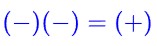
![Step 1: \begin{equation} (+)(+)=(+)\>\>\>\>(1) \end{equation} \begin{equation} (+)=(+) \>\>and\> (-)=(-) \>(2) \end{equation} Where equation (1) and (2) are axioms, \\ To proof $(-)(-)=(+)$: Let, \[(-)(+)=(+)\] By plugging equation (1), then \[(-)(+)=(+)(+)\] By cancelling $(+)$ in both sides, then we obtain: \[(-)=(+)\] This is contradicted to equation (2). Therefore, \begin{equation} (-)(+)=(-)\>\>\>\>(3) \end{equation} Step 2: \\ Let, \[(-)(-)=(-)\] By plugging equation (3), \[(-)(-)=(-)(+)\] By cancelling $(-)$ in both sides, then we obtain: \[(-)=(+)\] This is contradicted to equation (2), then must, \[(-)(-)=(+)\]](https://mako-sawin.com/wp-content/ql-cache/quicklatex.com-478f810b2a99fc80f1978e657c4c2ae5_l3.png "Rendered by QuickLaTeX.com")
The Ancient Studies
When I was in high school, this question crossed my mind and I asked my teacher why multiplying two negative numbers would be a positive? I was told this question is early to ask at your age. So I tried to derive by myself with this way,